
Chemistry is full of fascinating molecular reactions, and one such intriguing compound is HCOOCH CH2 H2O. This chemical expression may look a bit confusing at first glance, but it represents a hydrolysis reaction involving esters and water molecules. Understanding how it forms, reacts, and behaves in chemical environments can deepen your grasp of organic chemistry fundamentals.
In this article, we’ll explore what HCOOCH CH2 H2O means, its structure, formation, chemical properties, and real-world applications. We’ll also break down its reaction mechanism and importance in industrial chemistry, along with some helpful FAQ answers for students and researchers.
Understanding the Formula: HCOOCH CH2 H2O
At first sight, HCOOCH CH2 H2O seems like a mixed-up molecular formula — but when analyzed correctly, it represents a reaction process involving an ester and water, particularly methyl formate (HCOOCH₃) or similar organic compounds undergoing hydrolysis.
- HCOOCH₃ represents methyl formate, a simple ester.
- H₂O is water, which participates in a hydrolysis reaction.
When methyl formate reacts with water, it breaks down into formic acid (HCOOH) and methanol (CH₃OH). Thus, the correct chemical reaction is:
HCOOCH₃ + H₂O → HCOOH + CH₃OH
So, HCOOCH CH2 H2O can be interpreted as a shorthand representation of this hydrolysis reaction — where the ester reacts with water to produce an acid and alcohol.
Molecular Structure and Composition
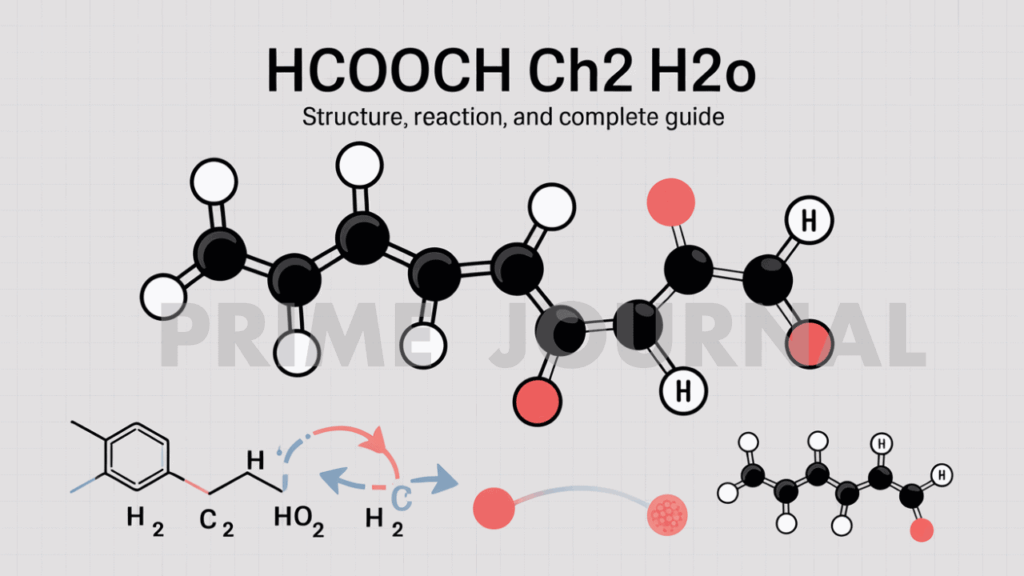
Let’s visualize the structure for better understanding.
Structural Representation
- Reactant (Ester):H-C(=O)-O-CH₃
- Water:H-O-H
- Products:
- H-C(=O)-OH (Formic acid)
- CH₃-OH (Methanol)
This reaction follows the general ester hydrolysis rule:
Ester + Water → Acid + Alcohol
Chemical Reaction and Mechanism
1. Reaction Equation
HCOOCH3+H2O→HCOOH+CH3OHHCOOCH_3 + H_2O rightarrow HCOOH + CH_3OHHCOOCH3+H2O→HCOOH+CH3OH
2. Reaction Type
This is a hydrolysis reaction — specifically, acid-catalyzed ester hydrolysis.
3. Catalyst Used
Typically, acidic (H⁺) or basic (OH⁻) conditions are required to accelerate the reaction. In acid hydrolysis, the proton helps in breaking the C-O bond of the ester linkage.
Step-by-Step Breakdown of Hydrolysis
To understand the mechanism clearly, let’s go step-by-step:
Step 1: Protonation of the Ester
The carbonyl oxygen of the ester gets protonated by an acid catalyst (e.g., H₂SO₄), increasing the electrophilicity of the carbonyl carbon.
Step 2: Nucleophilic Attack by Water
Water acts as a nucleophile, attacking the carbonyl carbon to form a tetrahedral intermediate.
Step 3: Proton Transfers
Several proton exchanges occur, rearranging the molecule for bond cleavage.
Step 4: Cleavage of the C-O Bond
The bond between the carbonyl carbon and alkoxy group (-OCH₃) breaks, forming formic acid and methanol.
Step 5: Product Formation
Final products are:
- Formic acid (HCOOH)
- Methanol (CH₃OH)
Physical and Chemical Properties
Note: Handle with care — both methyl formate and methanol are toxic and volatile.
Laboratory Preparation and Conditions
Required Materials
- Methyl formate (HCOOCH₃)
- Distilled water (H₂O)
- Sulfuric acid (H₂SO₄) – as catalyst
- Heat source (water bath)
- Condenser setup
Procedure
- Add methyl formate to a reaction flask.
- Introduce a few drops of sulfuric acid as the catalyst.
- Add distilled water carefully.
- Heat the mixture gently for 30-40 minutes under reflux.
- Cool and separate the formic acid and methanol layers.
Reaction Conditions
Industrial and Commercial Applications
The reaction HCOOCH₃ + H₂O → HCOOH + CH₃OH has several industrial applications, especially in organic synthesis and solvent production.
1. Production of Formic Acid
Formic acid is used in:
- Leather tanning
- Textile dyeing
- Rubber manufacturing
- Preservatives in livestock feed
2. Production of Methanol
Methanol, a versatile industrial alcohol, is used for:
- Solvent production
- Fuel (biofuel blends)
- Antifreeze
- Synthesis of formaldehyde and other chemicals
3. Organic Synthesis
This hydrolysis reaction serves as a model system to understand ester cleavage and reaction kinetics.
4. Laboratory Demonstrations
It’s a common educational experiment to demonstrate ester hydrolysis mechanisms in chemistry labs.
Safety, Storage, and Handling Precautions
Safety Tips
- Always perform reactions under a fume hood.
- Keep sources of ignition away.
- Dispose of chemical waste responsibly.
- In case of contact, rinse with plenty of water and seek medical attention.
Environmental Impact and Decomposition
- Formic acid and methanol are biodegradable, but large spills can pollute water sources.
- Controlled degradation ensures minimal impact on soil and aquatic life.
- The hydrolysis reaction itself is environmentally friendly since no harmful byproducts are released.
Comparison with Similar Compounds
Each of these follows the same general mechanism, differing only by the alkyl or acyl group involved.
FAQs
1. What is HCOOCH CH2 H2O in chemistry?
It represents the hydrolysis reaction of an ester (HCOOCH₃) with water (H₂O), producing formic acid (HCOOH) and methanol (CH₃OH).
2. What type of reaction is it?
It’s an acid-catalyzed hydrolysis — a reversible reaction where an ester breaks down in the presence of water.
3. What are the main products of HCOOCH₃ hydrolysis?
The products are formic acid and methanol.
4. Is the reaction reversible?
Yes. In fact, the reverse reaction (esterification) occurs when formic acid and methanol react to form methyl formate.
5. What is the industrial significance of this reaction?
It helps in the production of formic acid and methanol, both of which have extensive industrial applications.
6. What safety precautions should be taken?
Use proper personal protective equipment (PPE) — gloves, goggles, and lab coat. Avoid open flames due to the flammable nature of the chemicals.
7. How does temperature affect the reaction?
Higher temperatures accelerate hydrolysis but can lead to side reactions if uncontrolled.
8. Can it occur under basic conditions?
Yes, base-catalyzed hydrolysis (saponification) also occurs but yields salt of the acid instead of free acid.
Conclusion
The chemical expression HCOOCH CH2 H2O encapsulates one of the fundamental transformations in organic chemistry — ester hydrolysis. This reaction beautifully demonstrates how simple molecules can rearrange through controlled conditions to yield valuable compounds like formic acid and methanol.
Understanding its mechanism, industrial use, and environmental impact not only aids chemistry students but also helps industries design eco-friendly, efficient synthesis routes.
HCOOCH₃ + H₂O → HCOOH + CH₃OH is more than a formula — it’s the foundation of ester chemistry.
Want to dive deeper into organic reactions and hydrolysis mechanisms? Explore more chemistry insights in our related guides: